Dec 20, 2010 Mark Tushnetconlaw
Free speech theory has neglected – to the point where it is almost an embarrassment – the treatment of false statements of fact as such (that is, where they do not injure reputation). The Supreme Court has declared that no First Amendment value attaches to false statements of fact – and that there is no such thing, under the First Amendment, as a false idea. One reason for the theoretical neglect of false statements of fact may be that the examples that come to mind blend questions of fact and “ideas” (think of global warming and evolution). Another reason may lie in the chilling-effect argument – that the First Amendment requires that statements themselves lacking First Amendment value, such as false statements of fact, sometimes be immunized from liability out of fear that imperfections in the system of imposing liability will lead speakers to refrain from making true statements because they are worried that a decision-maker might wrongly conclude that the statements were false.
Frederick Schauer’s Nimmer Lecture does some essential ground-clearing on the basic theoretical questions. With his usual analytic care and clarity, Schauer distinguishes between basic facts and opinions, and defends the sensible anti-post-modern proposition that not all facts are socially constructed. The latter is particularly important because there is an understandable tendency to pose questions about regulation of false statements of fact by imagining when the government might want to impose liability, and the usual answers, at least in the United States, do touch on issues where post-modern anxieties might be well-placed (again, think global warming and evolution and even Holocaust denial, though Schauer contends otherwise as to the last).
Concerns about the chilling effect seem to be absent, or at least much weaker, when liability is imposed for lying – that is, for making false statements that the speaker believes to be false. (Weaker, perhaps, because there may be imperfections in determining whether the speaker had the required intent to lie.) One is hard-pressed to explain how the utterance of factual statements known to be false contributes to the discovery of truth, or to a well-functioning system of democratic self-governance. One can struggle to make Mill’s argument, that the very effort to refute false statements will strengthen a person’s commitment to the true statement, coherent: Maybe a person who believes something because she read it on Wikipedia will believe it “more” or “better” if, after being challenged by someone knowing the facts to be as the target believes them to be, she goes to three or four other confirmatory sources – but there’s some cost to “strengthening” the truth in the face of lies in that manner.
Personal autonomy is another matter. Everyone lies about something (“What were you doing before you came home at midnight last night?”), and giving the government the power to impose liability for such daily lies raises the specter of “1984.” This, which I call the “Don Draper” scenario (or, for an older version, the “Huck Finn” scenario on lighting out for the territories), is perhaps a better case for protecting deliberate untruths about oneself. Whether the best doctrinal home for this concern is the First Amendment is, I think, questionable; doctrines directly responsive to personal autonomy and privacy are more suitable, in my view.
Schauer shows that the government actually does impose liability for false statements of fact more often than the subject’s theoretical neglect might suggest. False statements under oath can be perjury; false advertising is prohibited; as Schauer has insisted again and again, false statements made in connection with the issuance of securities are criminalized; and nobody thinks that people should have a First Amendment defense to resume fraud. We can wave our hands about some of these, saying that they involve commercial speech, which is subject to lower standards of First Amendment review, and we can deal with perjury by saying that imposing liability for perjury satisfies whatever high standard of review we might want to invoke. The anti-paternalism theme in recent commercial speech doctrine, coupled with the idea that the preferred remedy for “bad” – here, false – speech is more speech, suggest to me that there’s more hand-waving going on than serious analytic inquiry.
Schauer exposes another reason for the neglect of false statements of fact in free speech theory. Regulation typically occurs in contexts where doctrine offers easy answers: commercial speech, or political campaigns where the line between fact and opinion may be exceedingly thin. So, to frame the problem clearly we need to think about situations in which a reasonable government might want to regulate false factual statements as such. Here’s one possibility: A board of education wants to encourage the children in its schools to aspire to academic excellence, and adopts a program that uses exemplars of academic achievement to encourage those aspirations – well-known figures who were Rhodes Scholars or members of Phi Beta Kappa. A civic activist in town, well-known as someone who rarely has much to contribute to public discourse, falsely states that he was a Rhodes Scholar. Prodded by the school board, the city council makes it a misdemeanor to (intentionally) falsely represent that you have won one of a list of academic honors. Should the civic activist have a First Amendment defense?
The example is not entirely hypothetical. Two federal courts of appeals have held unconstitutional the Stolen Valor Act, which makes it a federal crime to state, falsely, that you have won a Congressional Medal of Honor and some other military honors. I expect that the Supreme Court will take up the question soon. Schauer’s essay shows that the question the statute poses is genuinely novel within First Amendment theory and doctrine. It will provide the Justices – or at least their law clerks – with some important conceptual tools to apply to the problem.
Dec 17, 2010 Richard Murphyadlaw
H. Miles Foy III,
On Judicial Discretion in Statutory Interpretation, 62
Admin. L. Rev. 291 (2010),
available at SSRN.
There is something silly about Supreme Court decisions in which five justices explain that the conventional tools of statutory interpretation—e.g., legislative intent, objective textual meaning, and judicial rules for discerning and applying them—plainly indicate that a statute means A but the other four justices deploy the same tools to explain that the statute plainly means B. After all, if the relevant meaning were all that clear, wouldn’t all nine of the extraordinarily capable legal minds on the Court come to quick agreement? And isn’t their disagreement strong evidence that the statutory question has no pre-existing, determinate legal answer? One might expect that under such circumstances, the rules of reasoned legal discourse would require justices to make remarks like, “Wow. My dissenting colleagues’ arguments are really very good—they almost persuaded me—and I’m no pushover. But, on balance, I still think it is a better idea to choose interpretation A instead of B.” Instead, the more usual practice is for both sides to insist that the other is just plain wrong.
In his elegant essay, Professor Foy suggests courts dispense with such nonsense and instead tell the truth. Suppose, for instance, a judge determines that conventional tools of statutory interpretation do not compel a choice between readings A and B. The judge happens to think that the world would be a better place were she to choose B. Under the current rules of the game, the judge should write an opinion that tries to justify choosing B based solely on conventionally acceptable tools—which might include, say, old dictionaries. This sort of exercise can generate judicial explanations that are strained, arbitrary, or untruthful. According to Professor Foy, the judge should: (a) instead concede that interpretations A and B both seem pretty darn reasonable as a matter of conventional legal analysis, and then (b) truthfully explain whatever reasons of policy, equity, or justice moved the judge to choose one interpretation over the other. In short, judges should admit that they must exercise discretion when choosing among reasonable interpretations of ambiguous statutes and then exercise that discretion as prudently and transparently as they can.
I enjoyed Professor Foy’s essay for several intertwined reasons. First, it is a fun read. If statutes were written as clearly and lucidly as Professor Foy’s essay, then he would not have had to write it. The quality of the writing lends it persuasive force in a way that calls to mind that lawyers—and by extension, law professors—are supposed to be good at rhetoric. My favorite turn of phrase from the essay comes in Professor Foy’s dissection of Chapman v. United States (1991)—the case in which a majority of the Supreme Court relied in part on dictionary definitions to determine that LSD and blotter paper form a “mixture” for sentencing purposes. As Professor Foy remarked in a fairly devastating riposte, “[a] reasonably intelligent English speaker would not ordinarily use the word ‘mixture’ to describe a necktie stained with soup or a napkin soaked in cod liver oil.” Professor Foy’s essay is wise and wry.
Second, Professor Foy’s essay provides a novel angle for thinking about a very old problem. It is not, of course, news that statutory interpretation, in the hard cases, includes a discretionary element. Indeed, recognition of this point is a foundational element of the Chevron doctrine, which in essence instructs courts to affirm an agency’s discretionary choice among reasonable statutory constructions provided the agency gives a reasonable explanation for the choice. One can understand Professor Foy’s essay as insisting that courts apply the same standards of reasoned decision-making to themselves as they apply to agencies—what is good for the discretionary administrative goose is also good for the discretionary judicial gander.
Best of all, Professor Foy’s essay is thought-provoking. After reading it, I found myself mulling over, among other things:
- Would it really be better for courts to be more truthful about the discretionary nature of the task of interpreting ambiguous statutes?
- Are courts actually lying about this process even if no one believes them?
- Would greater judicial truthfulness about statutory interpretation tend to exacerbate or mitigate the role of ideology in this process?
- What would be the effect of judicial truth-telling on stare decisis? Where a judge admits that he or she chose an interpretation based on a personal policy preference, should that choice be entitled to weight in other cases?
- And, last but not least, what exactly do we mean by “discretion,” anyway?
So, there you have it: Professor Foy’s essay on discretion in judicial statutory construction is wise, wry, novel, and thought-provoking. You will enjoy reading it.
Dec 10, 2010 Michael Madisoncyber
The organization of the Internet raises some profound and fundamental questions about the nature of law and social order, questions that legal scholars have tackled head-on only occasionally and incompletely. If, as Lessig once argued, technical protocols effect a kind of “law” analogous to treaties, statutes, judgments, and administrative regulations, then by what standard should that “law” be regarded as legitimate and authoritative? Comparable questions have been asked from time to time with regard to informal social norms that seem to operate online, and more frequently with respect to the private but apparently governmental institutions, particularly the Internet Corporation for Assigned Names and Numbers (ICANN), that have evolved over the last decade to govern the wilds of the Net.
Lawrence Lessig, in Code and Other Laws of Cyberspace, and later Michael Froomkin, in Habermas@discourse.net, chose to look at legitimacy in cyberspace from the perspective of normative political theory. Jonathan Weinberg, in this chapter from the International Handbook on Informal Governance titled “Non-State Actors and Global Informal Governance – The Case of ICANN,” steers clear of such normative judgments and instead approaches the task explicitly as one of sociological, or descriptive, legitimacy. Legitimacy is important, as Weinberg, notes, in part because perceptions of an institution’s legitimacy powerfully impact willingness to comply with its commands or defer to its arrangements. Though he does not argue the case explicitly, legitimacy is central to institutional authority. Legitimacy and social order – online and off – go hand in hand.
Weinberg therefore renews a fundamental jurisprudential question, but by adopting a sociological framework, he enters territory only lightly trod by cyberlaw scholars. That turn enables him to base his argument not on first principles, but on descriptive analysis. The chapter is a case study, cleanly and evenly told, of the emergence and stabilization of ICANN as the private, non-governmental but nonetheless legitimate authority with respect to the ‘root’ that stores the technical specifications for the domain name system on (or of) the Internet.
The basic history of ICANN is repeated: Its formation as a California corporation entrusted with management of the root via a contract endorsed by the United States Department of Commerce, its promulgation of requirements and regulations to be followed by accredited domain name registrars, its endorsement of the Uniform Domain Name Resolution Policy (UDRP). Weinberg accurately characterizes all of this as a species of governance, perhaps not “collaborative” public/private governance in the sense developed in American administrative law scholarship, but “informal” governance in the flexible sense developed in European political theory. Within that “informal governance” framework, he tries on a series of possible accounts of the legitimacy of ICANN, its processes, and its outputs, finding each of them wanting. The organization tried to recover by establishing legitimacy via mastery of the technical standards governing administration of the root and asserting that its authority was limited solely to technical coordination. When its essential policy role quickly became apparent, ICANN tried to recover by adopting and following what appeared to be “democratic” processes, and by strategies of consensus-building among its “grass-roots” constituents. Weinberg persuasively establishes the failure of these strategies.
He concludes, by contrast, that ICANN has succeeded in establishing its legitimacy when the organization is understood through the lens of what Powell & DiMaggio refer to as “institutional isomorphism”: the idea that an organization acquires legitimacy within its institutional setting by taking on the characteristics expected of it by client and constituent organizations. ICANN, as an essentially bureaucratic enterprise operating in an environment dominated by expectations offered by business-oriented constituents, succeeded in its legitimacy challenge by adopting the bureaucratic and professionalized character that was expected of it.
The relative brevity of the piece means that its central argument is not brought definitively to a conclusion. What does the ICANN experience tell us about the nature, meaning, and significance of legitimacy? Is it possible to conclude that ICANN, or any modern institution that blends governmental, democratic, technological, and bureaucratic justifications, is or is not “legitimate”? Weinberg focuses on the details of the case rather than an elaboration of theories of legitimacy, and in so doing he leaves the door open for a great deal of further scholarship in this vein.
Dec 6, 2010 Browne Lewistrustest
Charities have a legal duty to comply with the restrictions donors place on gifts. Most charities act in good faith and honor the conditions the donors place on the donations. Problems usually occur when internal or external events make it necessary for the charity to change the manner in which it is carrying out the donor’s intent. Persons objecting to those changes may go to court to prevent the charity from taking certain actions. The litigation does not benefit the charities or the donors. Professor Gary addresses this problem with a comprehensive and thought-provoking article. She starts with an explanation of charitable trust law and identifies the legal issues that can arise because donor intent is difficult to determine and to enforce.
Professor Gary starts the article discussing recent high profile cases involving disputes over donor restrictions on charitable gifts. The five cases Professor Gary highlights contain facts that are interesting enough to get the reader’s attention. By starting with illustrations of recent cases Professor Gary shows that the issues she examines in her article are timely and in need of resolution.
In order to resolve the cases Professor Gary mentions, the courts had to determine the intent of the donors with regards to the gifts. That task was made more difficult by the fact that the donors were dead. As a result, the courts were forced to rely upon testimony from persons representing the donors’ descendants and the charities to ascertain the donors’ original intent. In addition, the courts had to decide how to carry out the donor’s intent in light of changed circumstances. Professor Gray uses the cases to highlight the difficulty of identifying and giving effect to donor intent. According to Professor Gray, attorneys representing charities and attorneys representing persons making charitable donations should take steps to ensure that the donor’s intent is clear enough to avoid costly litigation.
When the donor, donor’s descendants, or state attorney general sues to enforce the charitable trust, the critical issue the court must resolve is usually whether or not the charity is distributing the funds in a manner that is consistent with the donor’s intent. Professor Gary states that resolution of the issue is complicated by the fact that it is difficult to determine the donor’s intent. The charity may be administering the trust in accordance with its interpretation of the donor’s intent. The problem is that words in a gift agreement or solicitation may be unclear and open to several different interpretations. Professor Gray analyzes several common problems that make it hard for courts to determine donor intent. Changed circumstances can make it difficult to identify the donor’s intent. At the time the gift is made, the donor may clearly express his or her intent with regards to the purpose of the gift. Nonetheless, it may be challenging for the court to predict what the donor would have wanted had he or she been able to anticipate the changed circumstances. The court has to decide if the donor’s intent would have changed based upon the new circumstances. The court’s interpretation of the donor’s intent may be further complicated by the fact that the interpretation of words changes over time. For example, the legal definition of “family” is always evolving.
Professor Gray takes a balanced approach when she addresses the issue of donor intent. She analyzes the importance of donor intent from the perspective of the charity, the donor and the public. The charity has ethical, economic and legal reasons for carrying out the donor’s intent. In order to adhere to the Standards of Professional Practice established by the National Society of Fund Raising Executives, a charity must take steps to honor the donor’s intent. Moreover, if a charity wants to be able to raise money, it must take steps to maintain the trust of potential donors. A charity with the reputation of ignoring donor intent is unlikely to get donors to make contributions. Furthermore, from a legal perspective, the state attorney general may investigate and file an action against a charity that disregards the donor’s intent. Consequently, the attorney general may take control of the gift away from the charity. This could also lead to more government scrutiny of the other funds that the charity administers. When the donor chooses one charity over another, the donor is putting his or her trust in that charity. The donor wants the charity to perform a task that the donor will not be able to undertake. Thus, the donor benefits when the charity carries out his or her intent. In addition, the sector of the public that benefits from the donor’s vision is protected when the charity carries out the donor’s intent. Since members of the public do not have standing to enforce the terms of a charitable trust, they must rely on the charity to use the funds in the manner indicated by the donor.
Professor Gray ends her article with a discussion of things lawyers representing donors and charities can do in order to avoid unnecessary litigation about donor intent. Professor Gray suggests that the parties draft a gift agreement that serves a two-fold purpose. The agreement should give a sufficient description of the donor’s intent. It should also be flexible enough to permit the charity to use discretion when carrying out the donor’s intent. In addition, Professor Gray urges donors to place fewer restrictions on contributions made to charities in order to allow those organizations to fund operational expenses, to implement new programs, to manage its assets, and to avoid unnecessary costs. Professor Gray also recommends that lawyers drafting gift agreements include provisions giving the donor, the donor’s estate, or the donor’s descendants standing to enforce the trust. This type of provision would be strengthened if the agreement contains a provision stating that the charity will not challenge the standing of those persons. In order to protect the intent of a dead donor, Professor Gray proposes that the gift agreement names another charity as a contingent beneficiary. Thus, if the primary charity fails to carry out the donor’s intent, the contingent charity would take the gift. Professor Gray acknowledges that costly litigation over donor intent hurts the charity and the persons acting on behalf of the donor. To avoid that consequence, Professor Gray opines that lawyers should include mediation clauses in their gift agreement. The parties would agree to go through mediation or arbitration to resolve disputes over donor intent. Professor Gray stresses that “the donation of a charitable gift should not be an adversarial process.” To that end, she encourages attorneys representing charities and donors to work together to draft a gift agreement that reflects the donor’s intent and gives the charity the flexibility to interpret that intent in light of changing times.
In light of the tough economic times, charitable donations are on the decline. Those charities fortunate enough to receive gifts must take appropriate actions to respect the donor’s intent and to avoid expensive litigation. The practical suggestions Professor Gray includes in her article will assist charities in accomplishing those goals.
Dec 5, 2010 Michael FroomkinAdministrative Law
- Lawrence W. Waggoner, The American Law Institute Proposes Simplifying the Doctrine of Estates (May 21, 2010). U of Michigan Public Law Working Paper No. 198, available at SSRN.
- Lawrence W. Waggoner, Curtailing Dead-Hand Control: The American Law Institute Declares the Perpetual-Trust Movement Ill Advised (June 1, 2010). University of Michigan Public Law Working Paper No. 199, available at SSRN.
- Lawrence W. Waggoner, The American Law Institute Proposes a New Approach to Perpetuities: Limiting the Dead Hand to Two Younger Generations (June 1, 2010). University of Michigan Public Law Working Paper No. 200, available at SSRN.
- Lawrence W. Waggoner, Congress Should Impose a Two-Generation Limit on the GST Exemption: Here’s Why (July 15, 2010). U of Michigan Public Law Working Paper No. 205, available at SSRN.

Michael Froomkin
Predictions have ranged from cybernetic anarchy (both utopian and distopian) to the instantiation of a fascistic regime of surveillance that would make Orwell look like a piker. Some see a winner-take-all economy of massive new monopolies emerging on the back of network effects, others see the growth of a new economy in which intermediaries are replaced by huge open networks of buyers and sellers trading with e-cash on anonymous electronic exchanges — and evading their taxes. Meanwhile enthusiasts of electronic democracy and popular empowerment offer a vision sharply at odds with that of Cassandras of globalization for whom the Internet provides yet another occasion for decision-making authority to seep away towards relatively undemocratic trans-national bodies. One would think that such contrasting predictions cannot all be correct. Strangely, however, there is at least some truth in each of them, for the Internet phenomenon is becoming as complicated as the world into which it is woven. The Internet is neither “fraud’s playground” nor democracy’s. Indeed, there is more than one “Internet”. Thus, today, lawyers and policymakers should not let themselves be blinded by the term, but rather must identify the very few areas where the Internet genuinely creates a radical change that requires a radical legal response, reserving for the large majority of cases a nuanced and evolutionary approach to the political and legal challenge of cheap worldwide digital communications.
The growth of the Internet has provided ample occasion for futurists to make bold predictions about the changes it will bring, and their consequences for markets, governments and persons.
As these consequences become evident, governments are responding with legislation and treaties designed to hasten or, more often, forestall those developments.
Predictions have ranged from cybernetic anarchy (both utopian and distopian) to the instantiation of a fascistic regime of surveillance that would make Orwell look like a piker. Some see a winner-take-all economy of massive new monopolies emerging on the back of network effects, others see the growth of a new economy in which intermediaries are replaced by huge open networks of buyers and sellers trading with e-cash on anonymous electronic exchanges — and evading their taxes. Meanwhile enthusiasts of electronic democracy and popular empowerment offer a vision sharply at odds with that of Cassandras of globalization for whom the Internet provides yet another occasion for decision-making authority to seep away towards relatively undemocratic trans-national bodies. One would think that such contrasting predictions cannot all be correct. Strangely, however, there is at least some truth in each of them, for the Internet phenomenon is becoming as complicated as the world into which it is woven. The Internet is neither “fraud’s playground” nor democracy’s. Indeed, there is more than one “Internet”. Thus, today, lawyers and policymakers should not let themselves be blinded by the term, but rather must identify the very few areas where the Internet genuinely creates a radical change that requires a radical legal response, reserving for the large majority of cases a nuanced and evolutionary approach to the political and legal challenge of cheap worldwide digital communications.
Dec 5, 2010 Michael Froomkin
- Lawrence W. Waggoner, The American Law Institute Proposes Simplifying the Doctrine of Estates (May 21, 2010). U of Michigan Public Law Working Paper No. 198, available at SSRN.
- Lawrence W. Waggoner, Curtailing Dead-Hand Control: The American Law Institute Declares the Perpetual-Trust Movement Ill Advised (June 1, 2010). University of Michigan Public Law Working Paper No. 199, available at SSRN.
- Lawrence W. Waggoner, The American Law Institute Proposes a New Approach to Perpetuities: Limiting the Dead Hand to Two Younger Generations (June 1, 2010). University of Michigan Public Law Working Paper No. 200, available at SSRN.
- Lawrence W. Waggoner, Congress Should Impose a Two-Generation Limit on the GST Exemption: Here's Why (July 15, 2010). U of Michigan Public Law Working Paper No. 205, available at SSRN.
The growth of the Internet has provided ample occasion for futurists to make bold predictions about the changes it will bring, and their consequences for markets, governments and persons.
As these consequences become evident, governments are responding with legislation and treaties designed to hasten or, more often, forestall those developments.
Predictions have ranged from cybernetic anarchy (both utopian and distopian) to the instantiation of a fascistic regime of surveillance that would make Orwell look like a piker. Some see a winner-take-all economy of massive new monopolies emerging on the back of network effects, others see the growth of a new economy in which intermediaries are replaced by huge open networks of buyers and sellers trading with e-cash on anonymous electronic exchanges — and evading their taxes. Meanwhile enthusiasts of electronic democracy and popular empowerment offer a vision sharply at odds with that of Cassandras of globalization for whom the Internet provides yet another occasion for decision-making authority to seep away towards relatively undemocratic trans-national bodies. One would think that such contrasting predictions cannot all be correct. Strangely, however, there is at least some truth in each of them, for the Internet phenomenon is becoming as complicated as the world into which it is woven. The Internet is neither “fraud’s playground” nor democracy’s. Indeed, there is more than one “Internet”. Thus, today, lawyers and policymakers should not let themselves be blinded by the term, but rather must identify the very few areas where the Internet genuinely creates a radical change that requires a radical legal response, reserving for the large majority of cases a nuanced and evolutionary approach to the political and legal challenge of cheap worldwide digital communications.
Cite as: Michael Froomkin,
First Test of Version 1.2, JOTWELL
(December 5, 2010) (reviewing Lawrence W. Waggoner, The American Law Institute Proposes Simplifying the Doctrine of Estates (May 21, 2010). U of Michigan Public Law Working Paper No. 198, available at SSRN. Lawrence W. Waggoner, Curtailing Dead-Hand Control: The American Law Institute Declares the Perpetual-Trust Movement Ill Advised (June 1, 2010). University of Michigan Public Law Working Paper No. 199, available at SSRN. Lawrence W. Waggoner, The American Law Institute Proposes a New Approach to Perpetuities: Limiting the Dead Hand to Two Younger Generations (June 1, 2010). University of Michigan Public Law Working Paper No. 200, available at SSRN. Lawrence W. Waggoner, Congress Should Impose a Two-Generation Limit on the GST Exemption: Here's Why (July 15, 2010). U of Michigan Public Law Working Paper No. 205, available at SSRN. ),
https://zetasec.jotwell.com/first-test-of-version-1-2/.
Dec 3, 2010 Stacey Doganip
Sonia K. Katyal,
Stealth Marketing and Antibranding: The Love that Dare Not Speak Its Name,
58 Buff. L. Rev. 795 (2010).
How many law review articles begin with a scene from Wayne’s World? For Sonia Katyal, such an opening is par for the course. Since she entered the scene a decade ago, Katyal’s scholarship has celebrated irreverence, and examined the ways in which the law tolerates, enables, and often discourages commentary on dominant culture, icons, and in this case, brands. This essay – written for a symposium on advertising and the law at SUNY Buffalo Law School – continues the Katyal tradition.
In Stealth Marketing, Katyal takes up the question of whether and how the law should deal with the increasing convergence between speech from trademark holders and speech about trademark holders. The essay picks up on a phenomenon that Ellen Goodman raised several years ago in her article, Stealth Marketing and Editorial Integrity, 85 Tex. L. Rev. 83 (2006). Goodman’s piece had explored the various ways in which advertisers pay to slip their messages into communicative products, leaving consumers uncertain as to the objectivity or veracity of the content they consume. Goodman’s inquiry focused on the extent to which the law can or should require disclosure when a business, advocacy organization, or even an arm of the government pays to have its messages incorporated into a third party’s communicative work.
Katyal’s essay observes that the growth of stealth marketing has coincided with another cultural phenomenon: the use of “anti-branding” by commentators seeking to shape popular perception of dominant brands. Anti-branding involves the use of a brand to comment on the brand itself or to make a broader social commentary about advertising, consumerism, or some other political or societal concern. Katyal gives several colorful examples of anti-branding. Take the Absolut Nonsense campaign:
[A]n image of an Absolut vodka bottle is depicted with the slogan, “Any suggestion that our advertising campaign has contributed to alcoholism, drunk driving, or wife and child beating is absolute nonsense. No one pays any attention to advertising.” (P. 807).
As Katyal points out, this use of the ABSOLUT mark arguably aims at several different targets at once: the ABSOLUT vodka product, the ABSOLUT marketing campaign, and the general practice of advertising. (One could easily add other satirical targets to this list, including our society’s widespread denial of alcohol’s harmful effects.). More generally, anti-branding seeks to “expose, dissect, and then recode messages in advertising.” (P. 811). It uses marks to convey a message that may be complementary, oppositional, or orthogonal to the one cultivated by the trademark holder, but that comes from a distinct – and often critical – source.
Although Katyal spends some time exploring the extent to which the law allows or obstructs various forms of anti-branding, her real goal in this essay is to make a different point: that the existence of this often irreverent, ironic, edgy, and unauthorized use of marks further complicates consumers’ perception of the many different communicative forms in which they encounter trademarks in their everyday lives. As Katyal observes, stealth marketing itself has begun to take on some of the characteristics of anti-branding, by using third-party agents and sometimes self-mocking messages to enhance brand awareness among consumers. In the afore-mentioned Wayne’s World scene, for example, the actors ridiculed the idea of product placement while guzzling and gobbling brand name food and drinks on-screen. As stealth marketing itself becomes edgier, stealthier, and more irreverent – and as it broadens the cast of spokespeople paid to achieve its commercial objectives – consumers may have an ever-harder time distinguishing between messages conveyed by objective third parties and those delivered, sponsored, or paid for by the trademark holder. Anti-branding and stealth marketing, in other words, may become increasingly indistinguishable.
Katyal does not fully develop the normative implications of her insights, nor does she pretend to. She gives an approving nod to suggestions by Rebecca Tushnet and Ellen Goodman to increase disclosure of payments to those who tout, mention, or otherwise promote particular brands. And she mentions the Federal Trade Commission’s recent movement in that direction. But the essay’s real value lies in its artful description of the complex ways in which old-fashioned branding, anti-branding, and stealth and guerrilla branding appear, overlap, and interact, and the implications for our information-overloaded society. Besides, it’s an awfully fun read.
Dec 1, 2010 Ruth Masontax
Erik M. Jensen,
The Individual Mandate and the Taxing Power, Case Research Paper Series In Legal Studies, Working Paper 2010-33 (September 2010), available at
SSRN.
Even though it is Congress’s first enumerated power, appearing in the Constitution ahead of the power to regulate interstate commerce, the tax power doesn’t get much attention in court cases, law journals, or newspaper articles. It is, however, the Constitution’s hidden giant. The Constitution doesn’t express many limits on the scope of the tax power, other than the requirement that taxing (and spending) must be “for the General Welfare.” And the Supreme Court has interpreted Congress’s tax power broadly, finding taxes constitutional even when they have regulatory effects that Congress could not have achieved directly under the Commerce Clause.
Constitutional scholars have been debating whether the individual mandate of the health care act, which inserts into the tax code a penalty that applies to certain people who fail to purchase private insurance, exceeds Congress’s power under the Commerce Clause. Suits against the federal government in Virginia and Florida by the attorneys general of 20 states claim that the health care law—in particular the individual mandate—is unconstitutional because it exceeds Congress’s constitutionally enumerated powers.
The federal government has responded that Congress was within its power under the Commerce Clause to enact health care reform, and that even if the act exceeds the scope of the Commerce Clause, the individual mandate nevertheless represents constitutional exercise of Congress’s taxing power. Likewise, in an amicus brief in the Virginia case, constitutional law professors Jack Balkin, Gillian Metzger, and Trevor Morrison argue that the individual mandate is an indirect tax that falls within the tax power.
The constitutional law professors’ brief should be read in conjunction with tax power expert Erik Jensen’s recent paper on the same topic. Although Jensen offers no opinion on the constitutionality of the individual mandate under the Commerce Clause, he is considerably more skeptical of its validity under the tax power. First, Jensen doubts whether the individual mandate is a tax, in part because Congress did not label it a tax. He notes that placement of monetary penalties in the Internal Revenue Code does not automatically convert them to taxes. After all, he points out, the Internal Revenue Code provides penalties for the failure to pay taxes, but these penalties do not themselves constitute taxes.
Jensen’s gives a methodical and straightforward explanation of the relevant tax power precedent and how it applies to the question of the constitutionality of the individual mandate. A short review piece like this one cannot hope to summarize all the arguments Jensen makes in his over 40page article, so the purpose of this review is to recommend that readers interested in this issue should read both his article and the briefs and other documents filed so far in Virginia and Florida cases, which can be downloaded from Brad Joondeph’s ACA Litigation Blog. For another argument that the tax power cannot be used to justify the individual mandate, readers can look to a working paper by Randy Barnett.
Jensen’s article is useful for understanding how the tax power works. Jensen explains that if the mandate is a tax, then it would be subject to one of two constitutional restrictions on taxation, namely, uniformity (if it is an indirect tax) or apportionment (if it is a direct tax). If the mandate is an indirect tax, it will have no trouble satisfying the uniformity requirement, which requires the tax rules to be the same in New York as they are in Montana. But if the mandate is a direct tax that is not an income tax, it would be unconstitutional because it would fail the apportionment requirement, under which the amount collected from each state has to be proportional to its population. Jensen warns that if the individual mandate is a direct tax that is not an income tax, it will be unconstitutional for failure of apportionment, even if Congress has the power to enact healthcare reform under the Commerce Clause. This line of analysis, which applies to any tax, can be represented graphically as follows:
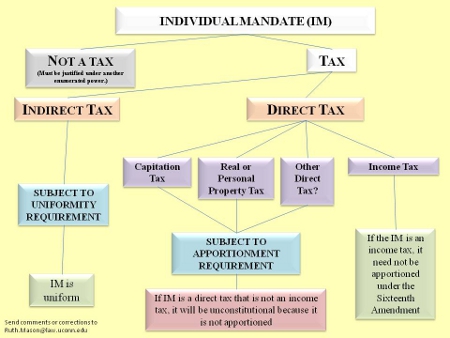
For a chart with more details, click here.
Nov 24, 2010 Samuel Issacharoffconlaw
Eugene Kontorovich,
“A Guantanamo on the Seas”: The Difficulty of Prosecuting Pirates and Terrorists, 98 Cal. L. Rev. 243 (2010).
Eugene Kontorovich has struggled to return the outlawry of pirates to the legal agenda. Admittedly, he has had some assistance from brigands off the coast of Somalia and in the Indonesian Straits of Malacca. Nonetheless, as world attention turns to the indeterminate status of non-state actors who practice a form of warfare unencumbered by uniforms, the principle of distinction from civilians, or any of the evolved norms of respect for civilians, medical personnel and countless other features of the law of war, the legacy of clear international legal rules governing pirates seems like an attractive safe harbor. Surely nothing is more settled than the fact that pirates are hostis humani generis, enemies of all mankind, for whom jurisdiction is universal and punishment merciless.
Or so it would seem. As Kontorovich well tells the tale, in the intervening centuries many international conventions have emerged reflecting both more sophisticated international relations and the emergence of human rights norms. Among these are the Geneva Conventions, other sources of international humanitarian law, refugee laws, and international laws of the seas.
Kontorovich notes:
None of these measures were designed to obstruct antipiracy efforts; the conventions were generally adopted without any thought about a resurgence of high sea piracy. But the growth of international legal norms that limit state authority and provide greater protection for individuals make it harder for nations to perform the oldest and perhaps most basic law enforcement function in international law: preventing privacy. (P. 246.)
Kontorovich’s examination of the current difficulties in prosecuting pirates, even as domestic criminal laws clearly cover such acts, is a cautionary tale about the assumption that inherited categories of either international law or ordinary criminal law can well address the problem of non-state terrorism. Consider the case of five Somalis picked up by a Dutch navy detachment patrolling the Somali coast and called upon to defend a ship registered in the Dutch Antilles. The five were charged under a 17th century law addressing “sea robbery.” During the capture, however, the pirate vessel was sunk, together with all the incriminating evidence. The Somalis were defended under the modern criminal procedure of the Netherlands, including challenges to the lack of evidence, and sentenced under its lenient criminal laws, which include consideration of the economic plight of Somalia. The pirates received five-year sentences, minus time served, a far cry from the customary execution of pirates. In the meantime, the pirates have asked for asylum and for the right to have their extended families immigrate to the Netherlands.
The difficulty of transposing piracy from a simpler era to the modern world of procedural rights and individual protections is a great cautionary tale for the simple solutions to the problem of international terrorism. Much of the debate on the detention and prosecution of terrorists takes the form of a battle over categories, with the assumption that with the category comes the answer. Either suspected terrorists are criminals, or they are unlawful combatants outside the bounds of international humanitarian law. The civil libertarian left argues the first position and assumes that domestic prosecution follows. The Bush administration took the second position, and then claimed that there were accordingly no legal restraints. The Obama administration has uncomfortably tried to find a way to steer between both poles. With each position comes a bending of categories, either through the expansion of inchoate crimes of material aid to terrorism, or through the unseemly use of detentions in violation of the common articles of the Geneva Conventions. Others have taken up the resulting “juridification” of the attempt to reduce war to the domain of criminal law (the term is from the excellent discussion in Gerry Simpson’s, Law, War & Crime). Kontorovich’s is the most careful examination of the original source of transnational prosecution of piracy.
A look back at the laws against piracy shows how little is resolved by the war of categories. For all the development of international law, its command is seriously compromised if “it cannot respond effectively to an atavism like piracy.” (P. 275.) Even resolved categories do not capture the nuances of the intersection between national enforcement and international law. To his credit, Kontorovich uses the fight with piracy to illuminate rather than resolve the more difficult questions of prolonged fights against international terrorist groups. The sense of international outlawry applies to both groups, but the common ground does not obliterate the differences between primarily financial actors and those motivated by ideology and religion. If new legal paradigms are needed to deal with pirates it follows that much work remains to address properly the new threat of international terrorism.
Nov 21, 2010 Michael Froomkin
John Hart Ely, The Wages of Crying Wolf: A Comment on Roe v. Wade, 82 Yale L.J. 920 (1973).
This post is set to have five paragraphs go to Zeta.
A decade ago the unregulated Internet was already subject to attempts to regulate: first-generation regulation was in full flow. Today a second wave of internet regulation is based on a better understanding of the Internet and of law’s ability to shape and control it. Some things about the second wave are encouraging, but even more is troubling. Internet regulation is increasingly based on a sound understanding of the technology, minimizing pointless rules or unintended consequences. But where a decade ago it was still reasonable to see the Internet technologies as empowering and anti-totalitarian, now regulators in both democratic and totalitarian states have learned to structure rules that cannot easily be evaded, leading to previously impossible levels of regulatory control.
First generation Internet regulation involved three differently motivated reactions to disruption.
1) Categorization. Was the Internet speech more like radio, or newspapers, or private letters? Was e-commerce like catalogue sales? Is encryption speech or a widget? Where is an online transaction? But the categories were contestable because the true nature of the Internet-mediated activity was unclear, analogies are imperfect, parties dueled about levels of generality, or category choice determined outcomes.
2) New categories and new institutions (e.g. ICANN). Either existing categories seemed inadequate, or new technology promised new capabilities or new solutions to old problems. Sometimes, proponents saw in the Internet an opportunity to achieve otherwise unjustifiable regulatory goals. Occasionally (e.g. digital signature regulation), enthusiasts enabled solutions that had yet to find problems.
3) Preserving (or reinstating) the status quo. As government attempts to set technical standards failed (e.g. the Clipper Chip), policy makers legislated more directly (e.g. the US’s DMCA and CALEA, the UK’s RIPA).